

Unit Circle
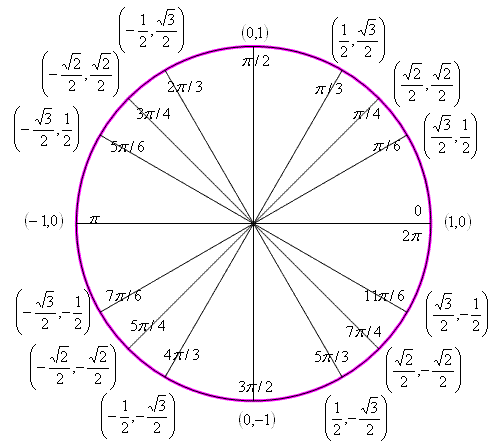
Pronunciation: /ˈju.nɪt ˈsɜr.kəl/ ExplainA unit circle is a circle with a radius of exactly 1.[1] The unit circle is used to define the sine and cosine functions.
|
| Figure 1: Unit Circle |
Relationship Between Unit Circle and Trigonometric Functions
In right triangle trigonometry, sine is defined as opposite/hypotenuse, and cosine is defined as adjacent/hypotenuse. Looking at the unit circle, the radius is the hypotenuse of a right triangle. The red leg of the right triangle (see manipulative 1) is the adjacent leg. So the cosine is equal to adjacent/hypotenuse. But, in the unit circle, the hypotenuse is always 1. So the cosine is always equal to the length of the adjacent leg of the right triangle. By a similar argument, the sine is always equal to the length of the blue leg, the opposite leg.
Circle Trigonometric Identities
| ||||||||
|
The circle trigonometric identities are equations that can be used to define trigonometric functions. Given a circle with a center at the origin, the trigonometric functions are defined using the x coordinate of a point on the circle (x), the y coordinate of a point on the circle (y), the radius of the circle (r), and the angle of rotation from an intersection of the circle and the x-axis(θ).
| ||||||||


References
- McAdams, David E.. All Math Words Dictionary, unit circle. 2nd Classroom edition 20150108-4799968. pg 186. Life is a Story Problem LLC. January 8, 2015. Buy the book
- unit circle. merriam-webster.com. Encyclopedia Britannica. Merriam-Webster. Last Accessed 12/17/2018. http://www.merriam-webster.com/dictionary/unit circle. Buy the book
More Information
- McAdams, David E.. Circle. allmathwords.org. All Math Words Encyclopedia. Life is a Story Problem LLC. 3/12/2009. https://www.allmathwords.org/en/c/circle.html.
Cite this article as:
McAdams, David E. Unit Circle. 12/21/2018. All Math Words Encyclopedia. Life is a Story Problem LLC. https://www.allmathwords.org/en/u/unitcircle.html.Image Credits
- All images and manipulatives are by David McAdams unless otherwise stated. All images by David McAdams are Copyright © Life is a Story Problem LLC and are licensed under a Creative Commons Attribution-ShareAlike 4.0 International License.
Revision History
12/21/2018: Reviewed and corrected IPA pronunication. (McAdams, David E.)12/17/2018: Removed broken links, updated license, implemented new markup, implemented new GeoGebra applications. (McAdams, David E.)
8/7/2018: Changed vocabulary links to WORDLINK format. (McAdams, David E.)
1/9/2010: Added "References". (McAdams, David E.)
11/27/2008: Added circle trigonometric identities. (McAdams, David E.)
9/15/2008: Expanded 'More Information'. (McAdams, David E.)
6/15/2008: Added manipulative for relationship between trigonometric functions and the unit circle. ( (McAdams, David E.)
3/11/2008: Changed See Also to match current standards. (McAdams, David E.)
8/18/2007: Initial version. (McAdams, David E.)
- Navigation
- Home
- Contents
-
# A B C D E F G H I J K L M N O P Q R S T U V W X Y Z - Teacher Aids
- Classroom Demos
- How To
- LIASP
- LIASP Home
- Conditions of Use
- Privacy Policy
- Donate to LIASP
- Help build this site
- About LIASP
- Contact LIASP
All Math Words Encyclopedia is a service of
Life is a Story Problem LLC.
Copyright © 2018 Life is a Story Problem LLC. All rights reserved.
This work is licensed under a Creative Commons Attribution-ShareAlike 4.0 International License