

Prime Factor
Pronunciation: /praɪm ˈfæk.təˌraɪ.zeɪ.ʃən/ ExplainPrime factors are a set of prime numbers or expressions that, when multiplied together, give a specific number or expression. Prime factorization is the process of finding all prime factors of a number.
A prime number is a number that is evenly divisible only by 1 and itself. A prime expresion is only divisible by one and itself. A prime factor may be a prime number or a prime expression. Examples of expressions that are prime include
- ( x + 1 )
- ( 3t - 2 )
- 6y
- 2x2 - 5x + 6
|
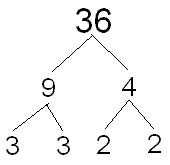
To find the prime factors of a number, you can use prime factorization to find all of the factors. The method most often used to get the prime factorization of a number is a factor tree. Figure 1 contains an example of a factor tree. If you can split each number in the tree into two or more factors, you split it. You stop when all the numbers at the bottom of the tree are prime numbers. |
References
- McAdams, David E.. All Math Words Dictionary, prime factorization. 2nd Classroom edition 20150108-4799968. pg 144. Life is a Story Problem LLC. January 8, 2015. Buy the book
More Information
- McAdams, David E.. Factor. allmathwords.org. All Math Words Encyclopedia. Life is a Story Problem LLC. 3/12/2009. https://www.allmathwords.org/en/f/factor.html.
Cite this article as:
McAdams, David E. Prime Factor. 4/28/2019. All Math Words Encyclopedia. Life is a Story Problem LLC. https://www.allmathwords.org/en/p/primefactorization.html.Image Credits
- All images and manipulatives are by David McAdams unless otherwise stated. All images by David McAdams are Copyright © Life is a Story Problem LLC and are licensed under a Creative Commons Attribution-ShareAlike 4.0 International License.
Revision History
4/28/2019: Changed equations and expressions to new format. (McAdams, David E.)3/28/2019: Changed title to 'Prime Factor'. Clarified wording. (McAdams, David E.)
12/21/2018: Reviewed and corrected IPA pronunication. (McAdams, David E.)
12/1/2018: Removed broken links, updated license, implemented new markup. (McAdams, David E.)
7/12/2007: Initial version. (McAdams, David E.)
- Navigation
- Home
- Contents
-
# A B C D E F G H I J K L M N O P Q R S T U V W X Y Z - Teacher Aids
- Classroom Demos
- How To
- LIASP
- LIASP Home
- Conditions of Use
- Privacy Policy
- Donate to LIASP
- Help build this site
- About LIASP
- Contact LIASP
All Math Words Encyclopedia is a service of
Life is a Story Problem LLC.
Copyright © 2018 Life is a Story Problem LLC. All rights reserved.
This work is licensed under a Creative Commons Attribution-ShareAlike 4.0 International License