

Proportional
Pronunciation: /prəˈpoʊr.ʃə.nl/ ExplainTwo variables are proportional if they have a common ratio.
An example of proportional values is the price of gasoline. Signs advertising
the price of gas give it in dollars per gallon. The price posted
is the common ratio. To calculate the total price, multiply the price per gallon
times the number of gallons. Given a price of $3.00 per gallon, This can be
expressed as a function t( g ) =
3g, where g is the number of
gallon of gas and t( g ) is the total
price of the gas. The graph in figure 1 represents this relationship.
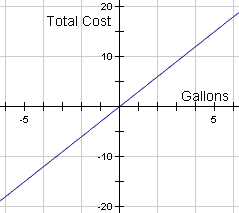 Figure 1: Graph of the function t( g ) = 3g which is directly proportional. |
Variables can be
directly proportional
or inversely proportional.
The example of gasoline prices is an example of
directly proportional.
An example of inversely proportional is the
time it takes to make a trip as a function of speed. The faster you go, the
quicker (less time) you get there.
This can be expressed with the function t(s)=100÷s
where t( s ) is the time it takes to
make the trip, 100 is the distance, and
s is the speed of travel. Figure 2 contains a
graph of this relationship.
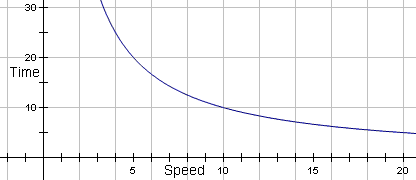 Figure 2: Graph of t( s ) = 100 / s which is inversely proportional. |
References
- McAdams, David E.. All Math Words Dictionary, proportional. 2nd Classroom edition 20150108-4799968. pg 146. Life is a Story Problem LLC. January 8, 2015. Buy the book
- Bettinger, Alvin K. and Englund, John A.. Algebra and Trigonometry. pp 57-58. www.archive.org. International Textbook Company. January 1963. Last Accessed 12/3/2018. http://www.archive.org/stream/algebraandtrigon033520mbp#page/n75/mode/1up/search/proportional. Buy the book
Educator Resources
- Crash - Graphs and NASA Langley. NASA Connect. 2/18/2010. http://www.archive.org/details/NasaConnect-Crash-GraphsAndNasaLangley/index.htm.
- Building Rockets (modeling and ratios). NASA Connect. 2/18/2010. http://www.archive.org/details/NasaConnect-Fof-BuildingRockets/index.htm.
- Building Rockets (modeling and ratios). NASA Connect. 2/18/2010. http://www.archive.org/details/NasaConnect-Fof-BuildingRockets/index.htm.
- Proportionality - Modeling the Future. NASA Connect. 2/18/2010. http://www.archive.org/details/NasaConnect-Proportionality-ModelingTheFuture/index.htm.
Cite this article as:
McAdams, David E. Proportional. 4/21/2019. All Math Words Encyclopedia. Life is a Story Problem LLC. https://www.allmathwords.org/en/p/proportional.html.Image Credits
- All images and manipulatives are by David McAdams unless otherwise stated. All images by David McAdams are Copyright © Life is a Story Problem LLC and are licensed under a Creative Commons Attribution-ShareAlike 4.0 International License.
Revision History
12/21/2018: Reviewed and corrected IPA pronunication. (McAdams, David E.)12/1/2018: Removed broken links, updated license, implemented new markup. (McAdams, David E.)
8/7/2018: Changed vocabulary links to WORDLINK format. (McAdams, David E.)
9/4/2008: Added 'More Information'. (McAdams, David E.)
6/7/2008: Corrected link errors. (McAdams, David E.)
7/12/2007: Initial version. (McAdams, David E.)
- Navigation
- Home
- Contents
-
# A B C D E F G H I J K L M N O P Q R S T U V W X Y Z - Teacher Aids
- Classroom Demos
- How To
- LIASP
- LIASP Home
- Conditions of Use
- Privacy Policy
- Donate to LIASP
- Help build this site
- About LIASP
- Contact LIASP
All Math Words Encyclopedia is a service of
Life is a Story Problem LLC.
Copyright © 2018 Life is a Story Problem LLC. All rights reserved.
This work is licensed under a Creative Commons Attribution-ShareAlike 4.0 International License